Highlights
- Stunning displays of the Northern Lights have been spotted across the UK, creating vivid hues in the night sky.
- The phenomenon, caused by solar activity, could be viewed further south than usual due to recent geomagnetic storms.
- While the aurora was a spectacle on Monday, forecasts suggest a decrease in visibility for subsequent nights.
Captivating Skies: A Rare Sight Across the UK
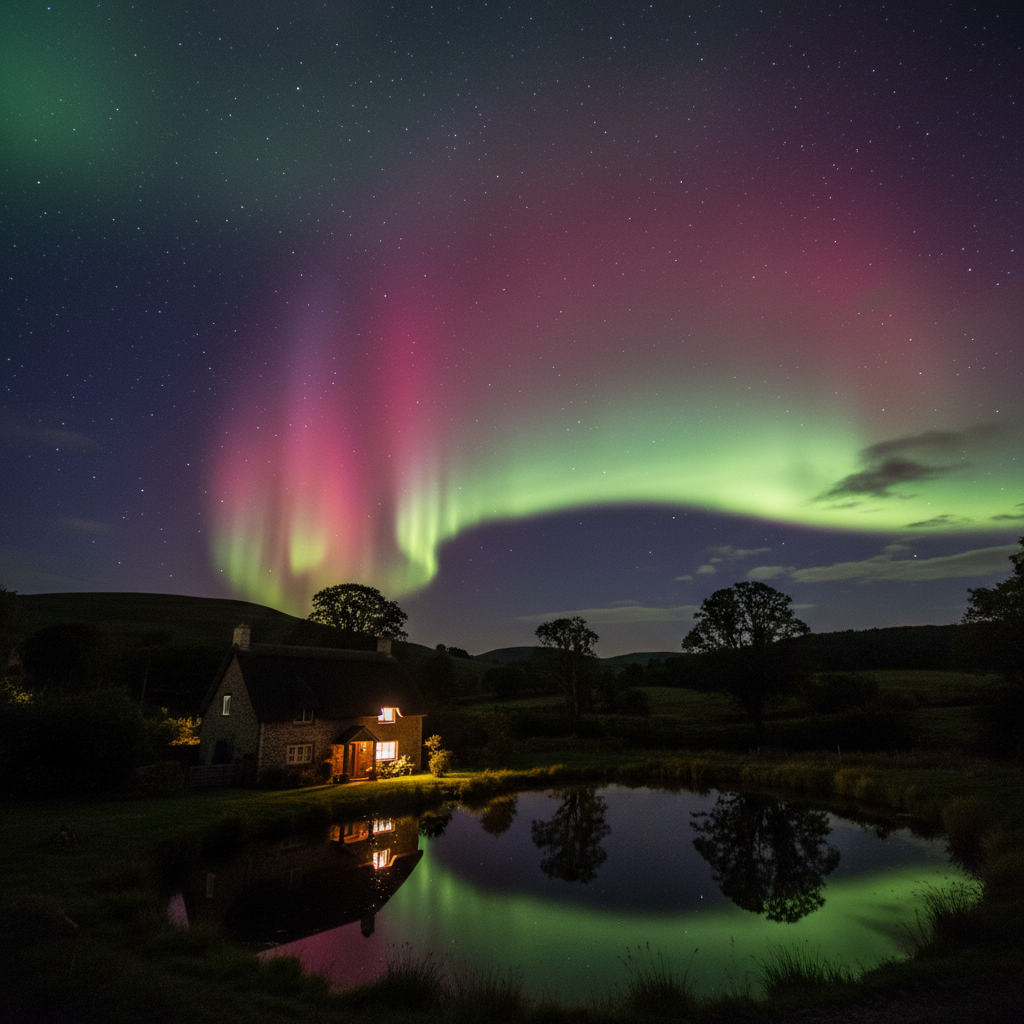
In a breathtaking display of natural beauty, the skies over the UK were treated to a dazzling show of the Northern Lights, popularly known as the Aurora Borealis. This remarkable phenomenon typically graces regions close to the Arctic Circle, but on occasion, high levels of solar activity allow it to be seen much further south. Recent reports of radiant green and pink lights sweeping across Scotland, Northern Ireland, Wales, and parts of England have left spectators in awe.
The Aurora Borealis originates from solar eruptions that propel particles toward Earth, which then interact with our atmosphere. The resulting collisions produce stunning visual effects that can illuminate the night sky, dazzling viewers lucky enough to catch a glimpse of this celestial occurrence. Photos shared by the public showcase vibrant landscapes bathed in otherworldly colors, making this a memorable event for many across the UK.
The Science Behind the Magic
This week’s auroras were notably thanks to a severe geomagnetic storm triggered by a coronal mass ejection (CME) from the sun, which released streams of charged particles into space. As these particles approach the Earth, they collide with gases in our atmosphere, producing magnificent glowing colors. For instance, oxygen manifests as green light while various forms of nitrogen emit shades of red, blue, and pink.
Currently, the sun is nearing its solar maximum in an 11-year cycle, a period characterized by heightened solar activity that includes an increase in sunspots and solar flares. This results in more frequent geomagnetic storms, allowing the Northern Lights to extend their reach. While these cosmic events pose no threat to life on Earth, they can disrupt technology and communication systems, which is an important consideration as we enjoy nature’s spectacle.
Future Implications and Viewing Opportunities
While the awe-inspiring auroras lit up the skies on Monday night, forecasts indicate that conditions for visibility may not be as favorable in the near future. Predictions show that the solar signal will weaken, leading to less vibrant displays in the following nights. Additionally, cloud cover in many regions could hinder viewing opportunities, though clear conditions might still allow some to experience the aurora in northern and eastern Scotland and parts of Northern Ireland.
To fully appreciate this mesmerizing phenomenon, enthusiasts are encouraged to seek clear environments away from city lights and look northward, ideally with a camera in hand. As we observe the Northern Lights, it raises questions about our relationship with natural phenomena and the impact of solar activity on both nature and technology. How can we better educate ourselves about these occurrences, and what measures can we take to mitigate the effects of geomagnetic storms on our daily lives?
In summary, the enchanting display of the Northern Lights across the UK serves as a powerful reminder of the beauty and complexity of our universe. As we venture into future nights, one can’t help but wonder how frequently we will witness such phenomena and what they signify for our world. Are we prepared to embrace these extraordinary natural events, and how can we enhance our understanding of their origins?
Editorial content by Dakota Sullivan